6th grade to Calculus

Math from 6th grade to Calculus

Every unit of US middle and high school math, with one method in three levels: you explore, you explain, then you solve. Pick your course, see what it covers, and practice in the app.

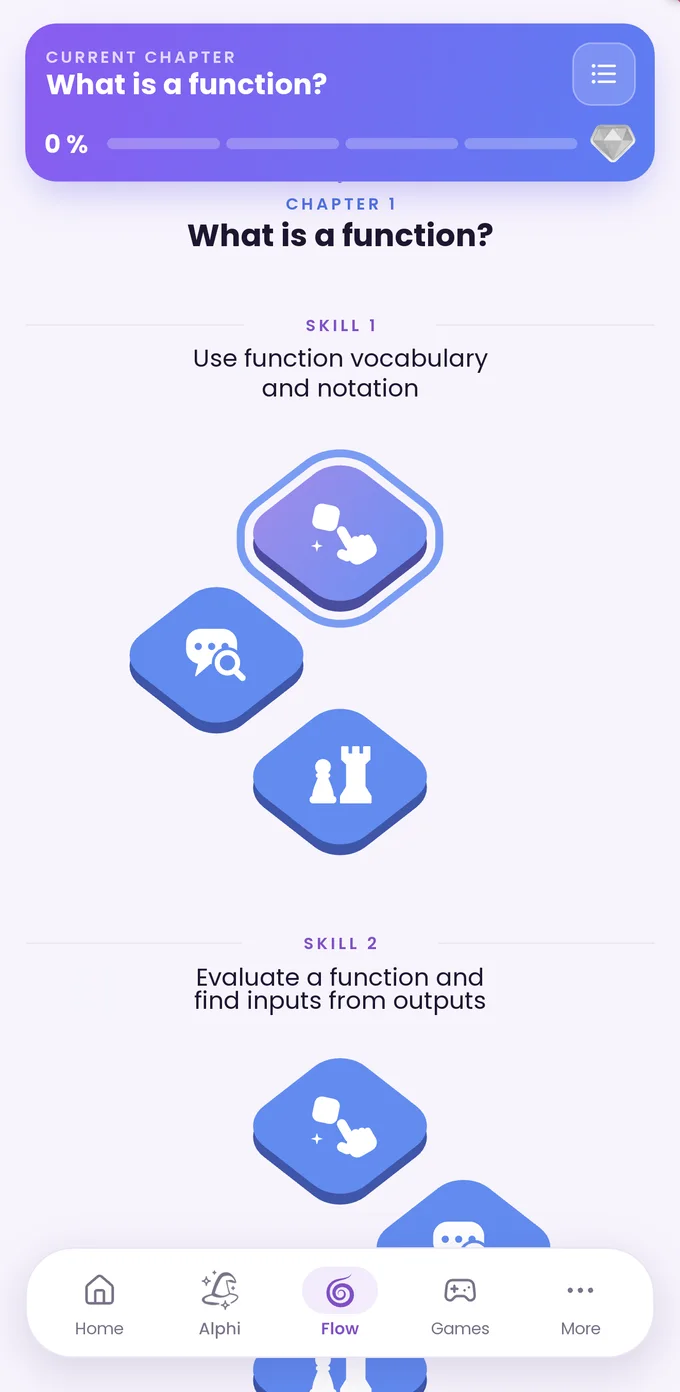
The Flow path in the Mathflow app: the current chapter and its series

The method

Every skill in three levels

The Mathflow method, built with Inria, follows the same progression for every skill of every course.

  • Level 1 · Explore

    Explore and play with the concepts to build your intuition.

  • Level 2 · Explain

    Turn your intuitions into the right words and uncover hidden mistakes.

  • Level 3 · Solve

    Reason it out, crunch the numbers, and find your way to the answer.

interactive series
950+
missions
9,500+
Chapter Challenges
90

US catalog, October 2026.

A unit of math is rarely just one thing to know. The 8th grade unit on the Pythagorean Theorem, for example, asks you to see why a2+b2=c2a^2 + b^2 = c^2 is true, to spot the hypotenuse, to find a missing side and to use the theorem in real situations. In Mathflow, every unit of your course is split into precise skills, and each skill is practiced in a series in three levels.

Level 1, Explore. You drag the foot of a ladder until its top reaches a window sill, or the corner of a screen until it makes a 50-inch TV. You see how the three sides of a right triangle depend on each other before you write a single equation.

Level 2, Explain. A 10-foot ladder leans against a wall: you decide which of two students is right about its height. You tap the first wrong line of a classmate’s work, and you complete the method for finding a missing leg. Explaining why a method works, and why another one fails, is what makes a concept stick.

Level 3, Solve. How far is it straight from home plate to second base? How far from the building does a wheelchair ramp start? You set up the calculation, type your answer and round it to the nearest tenth of a foot. This is the level of quizzes, unit tests and exams.

When you get stuck, Alphi, the AI math tutor, gives you a hint rather than the answer, at any hour. When the skills of a unit are in place, the Chapter Challenge checks them: 8 questions, 3 lifelines and a perfect score to earn the chapter gem.

The course pages on this site follow the same logic: what the course covers unit by unit, two worked problems to redo on your own, the common mistakes to avoid, and examples of each level from the app.

The courses

Choose your course

The units of each course in Mathflow. Open a course page for a summary of every unit, worked problems and common mistakes.

Middle school

6th, 7th and 8th grade math.

6th grade

21 units

Ratios and unit rates, dividing fractions, negative numbers, your first equations, area and volume, and a first look at statistics.

  • Introduction to Ratios
  • Ratios & Tables
  • Unit Rates
  • Percents & Conversions
  • Dividing Fractions
  • Decimals & Long Division
  • Factors & Multiples
  • Integers & Number Line
  • The Coordinate Plane
  • Exponents & Operations
  • Variables & Expressions
  • Equations
  • Inequalities
  • Two-Variable Relationships
  • Area of Polygons
  • Polygons & Coordinates
  • Volume
  • Surface Area & Nets
  • Introduction to Statistics
  • Measures of Center
  • Data Displays
See the course: 6th grade math

7th grade

16 units

Proportional relationships and percents, operations with negative numbers and fractions, equations and inequalities, circles, and probability.

  • Rates & Proportions
  • Proportional Equations
  • Percent Applications
  • Adding & Subtracting Integers
  • Multiplying & Dividing Integers
  • Rational Numbers
  • Simplifying & Factoring
  • Equations
  • Inequalities
  • Scale Drawings
  • Angle Relationships
  • Circles
  • Volume & Surface Area
  • Sampling & Inferences
  • Probability Basics
  • Compound Events
See the course: 7th grade math

8th grade

15 units

Irrational numbers, exponents and scientific notation, linear equations and systems, functions, transformations, the Pythagorean Theorem and scatter plots.

  • Rational vs Irrational Numbers
  • Approximating Irrationals
  • Exponents & Scientific Notation
  • Equations
  • Slope & Linear Graphs
  • Systems of Equations
  • Introduction to Functions
  • Linear Functions
  • Function Behavior
  • Transformations
  • Angles & Triangles
  • Pythagorean Theorem
  • Volume
  • Scatter Plots & Lines of Fit
  • Two-Way Tables
See the course: 8th grade math

High school

From Algebra 1 to Calculus.

Algebra 1

7 units

Linear equations, inequalities and functions, systems, exponential functions, polynomials and factoring, quadratic functions and data analysis.

  • Equations & Inequalities
  • Linear Functions & Graphs
  • Systems of Equations
  • Exponential Functions
  • Polynomials & Factoring
  • Quadratic Functions
  • Data Analysis
See the course: Algebra 1

Geometry

10 units

Transformations, congruence and proofs, similarity and right-triangle trigonometry, circles, coordinate geometry, 3D figures and probability.

  • Foundations & Logic
  • Congruence
  • Constructions
  • Similarity & Trigonometry
  • Circle Geometry
  • Coordinate Geometry & Conics
  • Modeling & 3D Figures
  • Conditional Probability
  • Further Geometry
  • Further Probability
See the course: Geometry

Algebra 2

7 units

Systems and matrices, complex numbers, polynomial, rational and radical functions, logarithms, trigonometric functions and statistics.

  • Linear Systems & Matrices
  • Complex Numbers
  • Polynomial Functions
  • Rational & Radical Functions
  • Exponential & Logarithmic Functions
  • Trigonometric Functions
  • Statistics & Probability
See the course: Algebra 2

Pre-Calculus

4 units

Polynomial and rational functions, exponential and logarithmic models, trigonometry and polar functions, parametric curves, vectors and matrices.

  • Polynomial & Rational Functions
  • Exponential & Logarithmic Modeling
  • Trigonometry & Polar Functions
  • Parameters & Linear Algebra
See the course: Pre-Calculus

Calculus

10 units

Limits, derivatives and their applications, integrals, differential equations, parametric and polar calculus, and infinite series.

  • Limits & Continuity
  • Derivatives
  • Composite & Implicit Differentiation
  • Rates & Local Approximation
  • Derivative-Based Function Analysis
  • Integration & Accumulation
  • Differential Equations
  • Integral Applications
  • Parametric & Polar Calculus
  • Infinite Series & Approximation
See the course: Calculus

Getting back into math as an adult? A good place to start is 6th to 8th grade math, then Algebra 1: see our guide to relearning math as an adult.

Frequently asked questions

What math classes do you take in middle school and high school?

In the usual US sequence, 6th, 7th and 8th grade math come first, then Algebra 1, Geometry and Algebra 2 in high school, often followed by Pre-Calculus and Calculus. Some students take Algebra 1 in 8th grade, and some schools use integrated courses instead.

What comes after Algebra 1?

In the traditional sequence, Geometry, then Algebra 2. Pre-Calculus usually comes next and prepares you for Calculus.

Does Mathflow follow the Common Core?

Mathflow’s middle school units are organized by the domains of the Common Core State Standards, and the high school courses cover Algebra 1, Geometry, Algebra 2, Pre-Calculus and Calculus. Unit names and order can differ from your school’s syllabus.

What is a Chapter Challenge?

The final check of a unit in the app: 8 questions, 3 lifelines, and a perfect score to earn the chapter gem. The US catalog has 90 of them, one per unit.

Is Mathflow free?

You can start for free. Premium costs $24.99 per month with no commitment, or $99.99 per year with a 7-day free trial. The Family plan costs $149.99 per year for up to 5 children and 1 parent account.

Math is all about flow.

Join 50,000+ learners improving with Mathflow. Free to start, on iOS and Android.