Adult learners
How to relearn math as an adult
Relearning math as an adult is more doable than it feels: this time, you know why you’re learning. Here’s a step-by-step plan, worked examples from everyday life, and honest advice on where to start.
Why adults go back to math
Most adults don’t relearn math for fun. They have a very concrete reason, and that’s an advantage: every skill pays off right away.
- A placement test for community college, a trade school or nursing program, or a career change that comes with a math test.
- Money decisions: sales, tips, sales tax, interest, paychecks, comparing two offers without a calculator app doing the thinking.
- Helping your kids with homework without freezing at a fraction or an equation.
- Confidence. Many adults carry a bad memory of school math, not a lack of ability.
If math feels rusty, you’re in good company. In the OECD’s 2023 Survey of Adult Skills, 34% of US adults aged 16 to 65 scored at or below Level 1 in numeracy (OECD average: 25%). At that level, people can do basic math with whole numbers or money, but may struggle with multi-step tasks such as solving a proportion. That’s exactly the kind of skill a short daily practice rebuilds.
- of US adults at or below Level 1 in numeracy (OECD, 2023)
- 34%
- a day: a realistic pace to start
- 15 min
- steps in the plan below
- 6
Start with your goal
Your reason for relearning math tells you where to begin, and what you can skip for now.
| Start with | Then move on to | |
|---|---|---|
| Managing money | Percents, ratios, mental math | Interest, budgeting, comparing offers |
| College placement test | Fractions, decimals, pre-algebra | Algebra I: equations, linear functions |
| Helping your kids | The topics of their grade | One grade ahead, to see where it leads |
| Trades or health programs | Ratios, unit conversions | Formulas, basic geometry |
How to make it stick
Work backward from your goal
A test date, a budget, a homework night: your goal decides the order of the topics.
Rebuild the foundations first
Fractions and percents carry everything else. Skipping them is why algebra felt impossible the first time.
Short and daily beats long and rare
Fifteen focused minutes a day build more than a two-hour cram session on Sunday.
Use real numbers from your life
Receipts, price tags, recipes, gas mileage: every one of them is a practice problem.
Understand before you memorize
A formula you understand comes back on test day. One you memorized blindly doesn’t.
Treat mistakes as data
A wrong answer shows exactly what to practice next. It says nothing about your ability to learn.
The 6-step plan
Plan on one to three weeks per step at 15 minutes a day. Move faster through what you already know.
- 1
Number sense and mental math
Times tables, multiplying by 10 or 0.1, estimating before you calculate: is a little under .
- 2
Fractions and decimals
Switching between forms, , and adding fractions with a common denominator.
- 3
Ratios, rates and unit prices
Proportions, scaling recipes, miles per gallon, price per ounce.
- 4
Percents
Discounts, tips, sales tax, percent increase and decrease, and why two discounts don’t simply add up.
- 5
Expressions and equations
Pre-algebra, then Algebra I: turning a word problem into an equation like and solving it.
- 6
Data and probability
Mean and median, reading a chart without being fooled, simple probabilities.
Everyday math, worked out
Seven situations you’ll actually run into. Try each one in your head first, then check the solution.
1. A 20% tip on a $64 check
Find 10% by moving the decimal point one place, then double it:
The tip is $12.80.
2. Two discounts in a row
An $80 jacket is 25% off, with an extra 20% off at the register. That is not 45% off, because the second discount applies to the already reduced price:
You pay $48, which is 40% off the original price. A true 45% discount would bring it down to $44.
3. Sales tax
Sales tax depends on your state and city. Say it’s 8%: a $50 item costs
Multiplying by 1.08 adds the tax in one step.
4. Which size is the better deal?
A 24 oz jar costs $4.80 and a 32 oz jar costs $5.76. Compare the price per ounce:
The big jar costs 18 cents an ounce versus 20 cents: it is the better deal.
5. Scaling a recipe
A recipe for 12 cookies calls for cup of sugar. For 18 cookies, multiply by :
You need exactly 1 cup of sugar.
6. Gas for a road trip
Your car gets 30 miles per gallon and the trip is 240 miles. With gas at $3.50 a gallon (an example price):
You need 8 gallons, about $28 of gas.
7. Setting up an equation
A ride costs a $2.50 base fare plus $1.75 per mile. Your ride cost $16.50. Call the number of miles :
The ride was 8 miles. Check: .
Relearning math with Mathflow
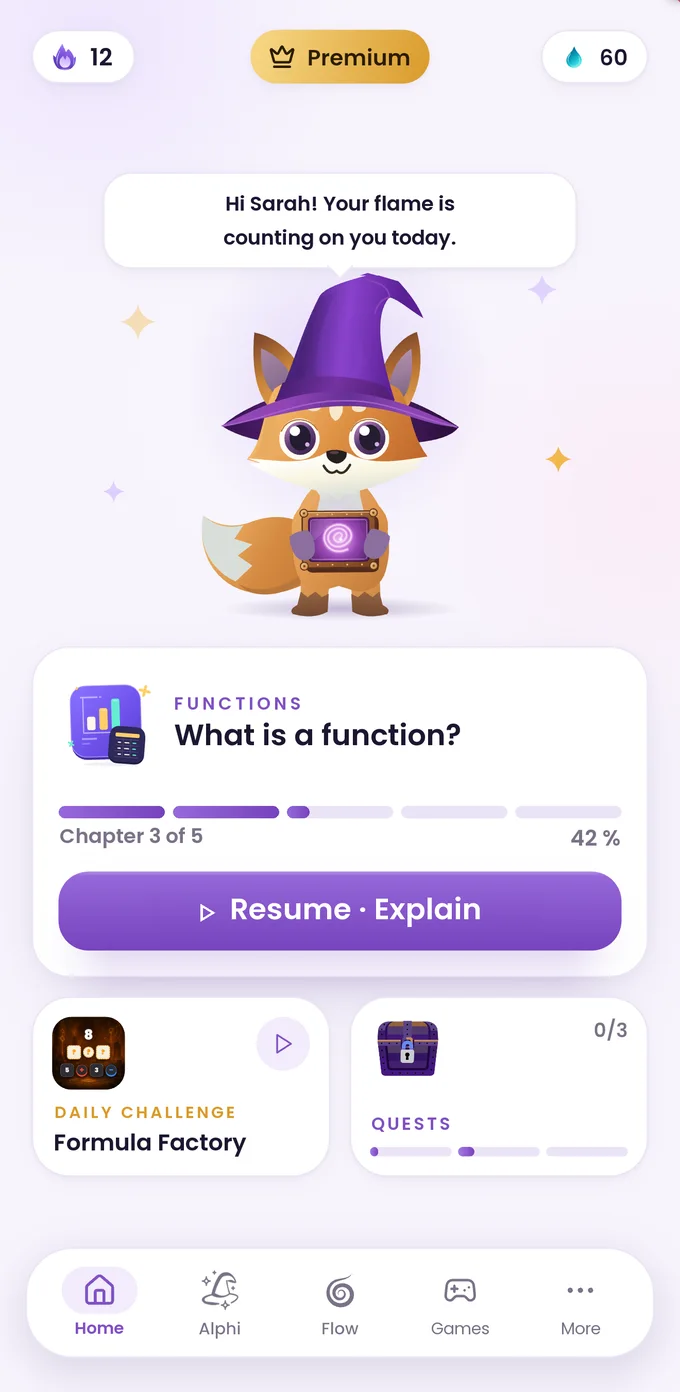
Mathflow follows the US curriculum from 6th grade to Calculus. For most adults, the sweet spot is 6th to 8th grade math (ratios, percents, expressions, equations), then Algebra I.
Hands-on, not multiple choice
Every skill comes in three levels, Explore, Explain and Solve. You move sliders, balance scales and drag points instead of guessing between options.
Alphi, your AI tutor
Snap a photo of a problem and Alphi works through it with you step by step, with hints rather than answers. Available 24/7, no judgment.
Chapter Challenges
8 questions, 3 lifelines and a perfect score to earn the chapter gem: a clear signal that a topic is really back.
A reason to come back
A daily challenge and a streak, protected by a freeze on the days life gets in the way.
Mathflow is free to start. Premium ($24.99 a month with no commitment, or $99.99 a year with a 7-day free trial) unlocks unlimited energy and every series, in the order you choose, so you can jump straight to the grade level you need.
Learn more about the three-level method, Alphi, the AI tutor and pricing, or see how an AI math tutor can help. Version française : remise à niveau en maths pour adulte.
Adults who got back into math
“The app took me by the hand and helped me improve without me even realizing it.” — Maxime, Adult
“A superb app for improving in math, even for adults who want to get back into it!” — Sébastien, Adult
Frequently asked questions
How can I relearn math as an adult?
Start from your goal, rebuild the foundations in order (mental math, fractions, ratios, percents, then equations), and practice about 15 minutes a day with numbers from your own life: receipts, recipes, budgets, gas mileage.
Where should I start if I forgot all my math?
Start with number sense and fractions. They are the foundation of percents, ratios and algebra, and most adults who struggled with algebra had gaps there first.
How long does it take to relearn basic math?
It depends on where you start and where you want to go. At 15 minutes a day, plan on one to three weeks per step of the plan above. Consistency matters more than the length of each session.
Is it too late to learn math as an adult?
No. Adults can learn math at any age, and they have an edge over students: they know exactly why they need it. Starting with real situations from your daily life keeps it concrete.
How do I relearn algebra as an adult?
Make sure fractions, negative numbers and percents are solid first, then work through pre-algebra (expressions, one-step and two-step equations) before Algebra I topics like linear functions and systems.
Is there an app to relearn math as an adult?
Mathflow covers the US curriculum from 6th grade to Calculus with hands-on activities in three levels, Chapter Challenges and Alphi, an AI tutor available 24/7. It’s free to start on iOS and Android.